.png)

GMC Canyon vs Ford Ranger: Which Mid-Size Pickup Is Right for You
Compare the 2026 GMC Canyon and Ford Ranger on price, power, towing, fuel economy, and comfort to find the right mid-size pickup for Monroe, NC drivers.
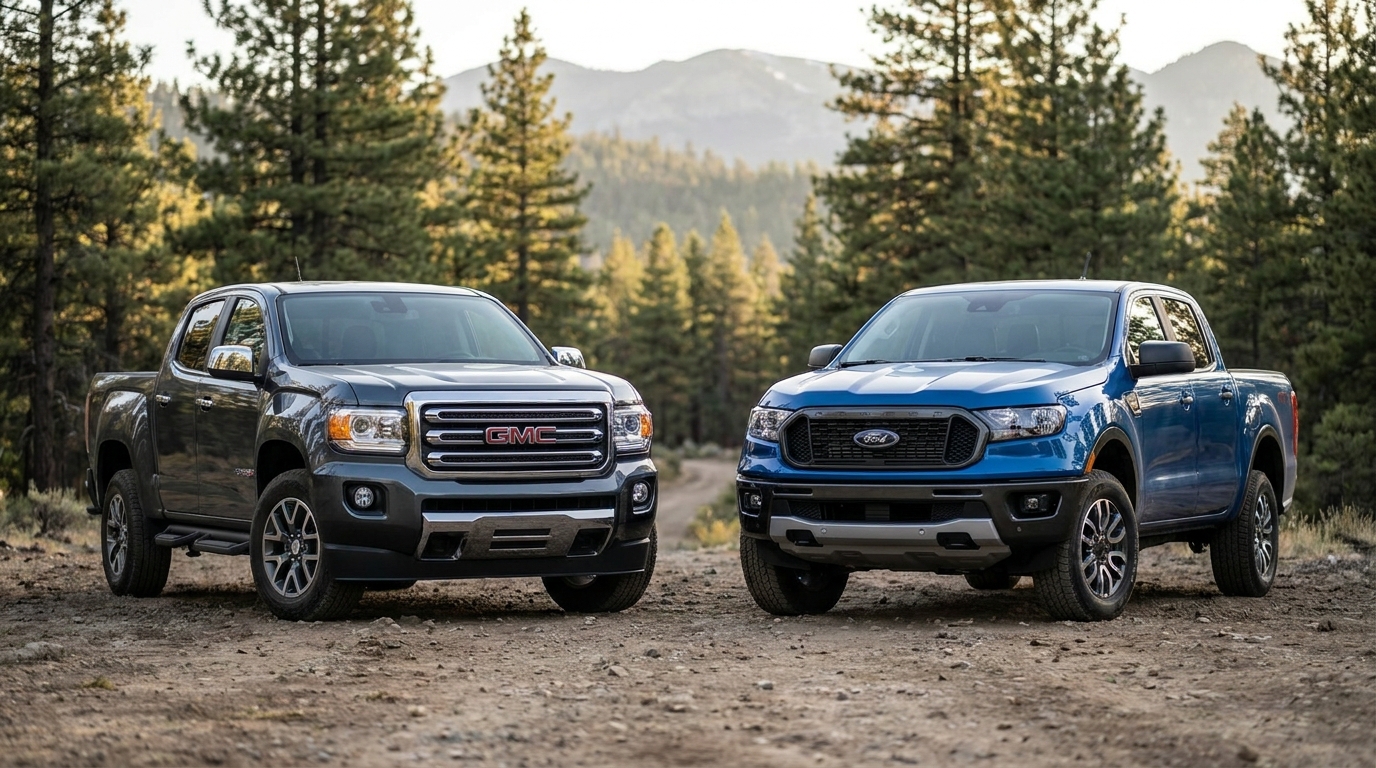
If you're shopping mid-size pickup trucks in Union County, the conversation almost always narrows to two names: the GMC Canyon and the Ford Ranger. Both are current-generation trucks built around turbocharged four-cylinder powertrains, both seat up to five, and both can handle weekend trips to Lake Tillery or a load of mulch from a garden center off Highway 74. But once you start digging into the spec sheets, the differences get real — and they matter depending on whether you're towing a boat, commuting into Charlotte, or hauling job-site gear around Monroe.
This guide walks through how the two trucks stack up across the dimensions that actually shape ownership: price, powertrain, towing, fuel economy, comfort, and cargo. We'll keep it specific to the 2026 model year, and we'll flag what we see day-to-day at Griffin Buick GMC when customers cross-shop these two.
Starting Price and Value
The Ford Ranger is the cheaper truck on paper. The 2026 Ranger XL starts at $33,350, while the 2026 GMC Canyon Elevation opens at approximately $38,900 including destination — a gap of roughly $5,500. Both numbers are before taxes and any dealer fees.
That base-price gap is real, but it tells only part of the story. The Canyon's lineup starts where the Ranger's mid-grade trims live. Every Canyon — Elevation, AT4, AT4X, and Denali — comes with the same 2.7L TurboMax engine making 310 horsepower and 430 lb-ft of torque. The Ranger spreads its capability across a wider trim ladder, from the value-focused XL up to the off-road Raptor, with different engines at different price points. If you want a near-luxury mid-size pickup, the Canyon Denali plays in a space the standard Ranger doesn't really enter.
Engine Power and Torque
This is where the Canyon flexes. The standard 2.3L EcoBoost in the Ranger XL and XLT produces 270 hp and 310 lb-ft of torque — capable numbers for a four-cylinder. But the Canyon's 2.7L TurboMax produces 310 hp and 430 lb-ft, and that 120 lb-ft torque advantage is something you feel every time you pull away from a stoplight on Roosevelt Boulevard or merge onto I-485.
Ford offers an available 2.7L EcoBoost V6 producing 315 hp and 400 lb-ft on higher Ranger trims, and a 3.0L EcoBoost V6 in the Raptor rated at 405 hp. The Raptor, however, is a specialty performance off-roader — it's not the right cross-shop against a Canyon Denali or AT4.
The Canyon routes power through an 8-speed automatic; the Ranger uses a 10-speed. Both are well-sorted transmissions, and on the road the difference is more about character than capability. The Ranger's additional gear spread can improve cruising refinement, but neither transmission is a weak point.
Towing and Payload
For shoppers who tow — and in this part of North Carolina, that often means a bass boat, a single-axle utility trailer, or a small camper headed to the Uwharrie National Forest — the Canyon edges out the Ranger. Maximum towing on the Canyon is 7,700 lb versus 7,500 lb on the Ranger. That 200-lb advantage is modest, but it's consistent across configurations.
The Ranger fights back on payload. Properly equipped XL and XLT trims can carry up to 1,767 lb in the bed. If your typical load is heavy materials — pavers, bagged concrete, tools — the Ranger has a measurable edge. If you're pulling a trailer, the Canyon is the stronger choice.
Fuel Economy and Driving Range
The Ranger wins fuel economy. The 2.3L EcoBoost returns up to 23 mpg combined in 4x2 configuration and 21 mpg combined in 4x4, while the Canyon comes in at 19–20 mpg combined depending on configuration.
If you commute into Charlotte daily, you'll see better numbers at the pump in the Ranger. If you're road-tripping toward the Outer Banks, the efficiency advantage adds up over the miles. Buyers who spend most of their time on the highway and want the best combined economy will consistently favor the Ranger's base powertrain.
Comfort, Interior, and Cargo
The Canyon's crew cab bed offers 41.9 cubic feet of cargo volume. The Ranger counters with a maximum payload rating of up to 1,767 lb in its best-configured 4x2 trim. Note that these figures measure different things — bed volume versus weight capacity — so they're not directly comparable; the right metric depends on what you're hauling.
The Canyon counters with more premium content as you climb the trim ladder. The Denali and AT4X bring materials, sound deadening, and technology that the Ranger lineup doesn't try to match outside the Raptor. Both trucks seat five passengers comfortably, and both offer genuine capability for the full range of mid-size truck buyers in Union County.
Overall, the Ranger is the more well-rounded daily driver for a wider range of buyers on a tighter budget, while the Canyon rewards drivers who prioritize torque, towing, and upper-trim refinement.
Warranty and Ownership
GMC backs the Canyon with a 3-year / 36,000-mile basic warranty, according to manufacturer specifications. Both trucks are supported by dealer service networks throughout the Charlotte metro area, and Griffin Buick GMC's service team handles Canyon warranty work locally —
Which Mid-Size Pickup Should You Choose?
Use this as a quick decision framework:
- Choose the GMC Canyon if you tow regularly, want the strongest standard torque in the segment, or want access to genuinely upscale trims like the Denali and AT4X.
- Choose the Ford Ranger if your priorities are a lower starting price, better fuel economy on your daily commute, higher payload, or you specifically want the Raptor's high-performance off-road package.
Frequently Asked Questions
Is the GMC Canyon more expensive than the Ford Ranger?
Yes. The 2026 Canyon Elevation starts at approximately $38,900 including destination, while the 2026 Ranger XL starts at $33,350 — a difference of roughly $5,500 before taxes and fees.
Which truck tows more, the Canyon or the Ranger?
The Canyon tows up to 7,700 lb versus 7,500 lb for the Ranger at maximum rated capacity. Tow ratings depend on specific configuration and equipment; always consult the manufacturer's towing guide for your exact setup.
Which mid-size pickup gets better fuel economy?
The Ford Ranger. The 2.3L EcoBoost returns up to 23 mpg combined (4x2) versus 19–20 mpg combined for the Canyon depending on configuration. The Ranger's fuel efficiency advantage is most pronounced in everyday commuting and highway driving.
Does the GMC Canyon come with different engine options?
No. Every 2026 Canyon trim uses the same 2.7L TurboMax turbocharged four-cylinder producing 310 hp and 430 lb-ft of torque, paired with an 8-speed automatic. The Ranger, by contrast, offers three engine options across its lineup.
How does the Ford Ranger's powertrain lineup compare to the Canyon's?
The Ranger offers significantly more powertrain flexibility. The base 2.3L EcoBoost produces 270 hp and 310 lb-ft, an available 2.7L EcoBoost V6 steps up to 315 hp and 400 lb-ft, and the Raptor's 3.0L EcoBoost V6 produces 405 hp. The Canyon offers one engine for all trims, which simplifies the buying decision but limits flexibility.
Which truck is better for off-road driving near Monroe?
Both offer dedicated off-road variants. The Canyon's AT4 and AT4X trims are tuned for serious trail work with purpose-built hardware, while the Ranger's Raptor is a performance-focused desert runner and the FX4 package upgrades lower Ranger trims. The Canyon AT4X and Ranger Raptor target different off-road buyer profiles; the right choice depends on the terrain and driving style you have in mind.
Where to Go From Here
Spec sheets only tell you so much. The right way to settle a Canyon-versus-Ranger decision is to drive both back-to-back, load the bed, sit in the second row, and see how each truck fits the life you actually live in Monroe. Customers consistently highlight the sales team's straightforward approach and the service department's professionalism. If you'd like to spend time behind the wheel of a 2026 Canyon — Elevation, AT4, Denali, or AT4X — the team at Griffin Buick GMC can put you in one and walk through configurations, towing setups, and trim-level differences in plain language. You can reach us at griffinmonroe.com when you're ready to compare in person.