.png)
How to Budget for a New Car Purchase: Complete Financial Planning Guide
Learn how to budget for a new car purchase with this 2026 financial planning guide for Monroe, NC buyers — covering down payments, taxes, and total cost.
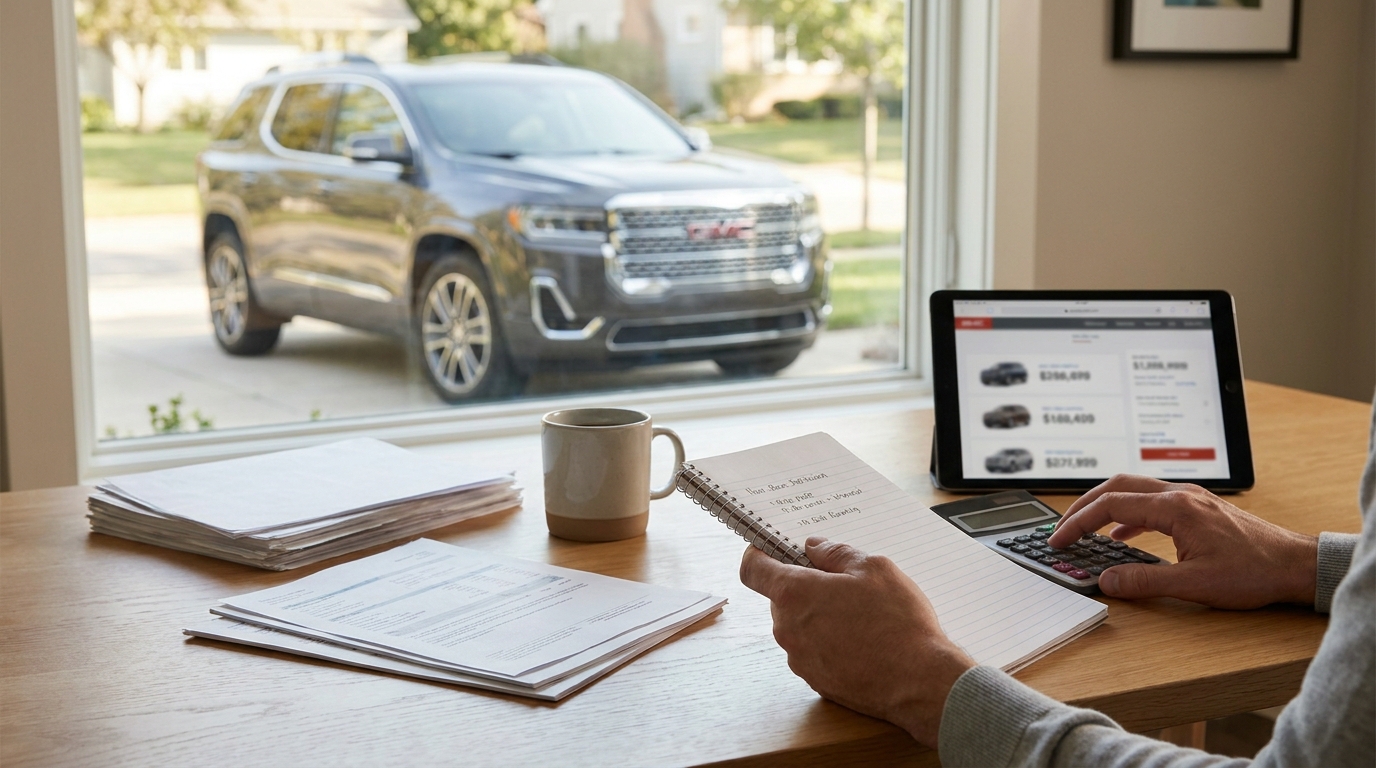
Buying a new vehicle is one of the larger financial decisions you'll make, and the math involves far more than a monthly payment. Between sales tax, registration, insurance, fuel, and maintenance, the true cost of ownership often runs 30–40% above the sticker price over the life of the vehicle. If you're shopping in Union County, this guide walks through how to build a realistic car buying budget — one that holds up after you drive off the lot.
Start With the 20/4/10 Rule as a Baseline
Financial planners have used the 20/4/10 rule for decades because it works for most household budgets. The framework is straightforward: put at least 20% down, finance for no more than 4 years, and keep total transportation costs (loan payment, insurance, fuel) under 10% of your gross monthly income.
For a household earning $6,500 per month in Monroe, that caps total transportation spending at roughly $650. If your auto insurance runs $140 and fuel costs another $180 for a typical commute up Highway 74 toward Charlotte, you're left with about $330 for a car payment. That math should drive your vehicle price ceiling — not the other way around.
Why the Down Payment Matters More Than You Think
A 20% down payment on a $40,000 vehicle is $8,000. That's a meaningful number, but it accomplishes three things: it offsets the immediate depreciation that hits new vehicles in the first year, it reduces the loan principal you pay interest on, and it lowers your loan-to-value ratio enough that lenders typically offer better rates. Buyers who stretch into 72- or 84-month loans with minimal money down often find themselves underwater within 18 months.
Calculate the True Cost of Ownership
The MSRP is only the starting point. When you're planning a new vehicle purchase, you need to layer in every recurring and one-time cost.
- North Carolina Highway Use Tax: Instead of a traditional sales tax, North Carolina charges a 3% Highway Use Tax on vehicle purchases, capped at $250 for commercial vehicles but uncapped for personal vehicles. On a $40,000 vehicle, that's $1,200 due at titling.
- Registration and title fees: The NCDMV charges title and plate fees that typically run under $100 combined, though specific amounts vary by vehicle type.
- Property tax: Union County assesses an annual vehicle property tax based on the vehicle's value — this is billed together with your registration renewal through North Carolina's Tag & Tax Together program. Budget for this every year, not just at purchase.
- Insurance: Get quotes before you buy, not after. A GMC Sierra 1500 and a Buick Encore GX will land in very different premium brackets.
- Fuel and maintenance: Monroe's mix of in-town driving on Roosevelt Boulevard and longer commutes toward Charlotte or Pineville means fuel economy matters. Plan for routine maintenance every 5,000–7,500 miles.
Know Your Trade-In Value Before You Walk In
Your existing vehicle is leverage. Before shopping, pull values from two or three independent sources (Kelley Blue Book, Edmunds, and your insurance carrier's valuation tool) so you have a defensible range. In North Carolina, the Highway Use Tax is calculated on the purchase price after the trade-in credit is applied — meaning a $10,000 trade on a $40,000 vehicle reduces your taxable amount to $30,000, saving you $300 in tax alone.
This is a meaningful difference from states like California, which tax the full purchase price regardless of trade. It's worth understanding how the credit applies before you negotiate.
Build Your Monthly Payment Around Total Budget, Not Sticker Price
Most buyers walk into a dealership focused on the wrong number. The question isn't "what's the payment on this truck?" — it's "what payment fits my budget, and what vehicles does that buy me?"
A Practical Worksheet
- Determine your monthly transportation cap (10% of gross income).
- Subtract insurance, fuel, and a maintenance reserve (typically $50–$100/month for a new vehicle under warranty).
- The remainder is your payment ceiling.
- Work backward to a loan amount using current 2026 rates — for buyers with strong credit, new-vehicle APRs are running in the 6–8% range, though manufacturer incentive rates on select Buick and GMC models can be considerably lower.
- Add your down payment and trade equity to determine your total purchase budget.
A $400 monthly payment at 7% over 60 months supports roughly a $20,000 loan. Add a $7,000 down payment and a $6,000 trade, and your realistic vehicle budget is around $33,000 out the door — meaning a sticker price closer to $30,500 once you account for tax and fees.
Don't Forget the Emergency Buffer
The single most common reason new-vehicle buyers run into trouble isn't the purchase itself — it's an unexpected expense in the months that follow. Tire replacement, a deductible after a fender-bender, or a job change can turn a comfortable payment into a stressful one. Experts at Griffin Buick GMC generally recommend keeping at least three months of car payments in a separate savings buffer before signing on a new vehicle, separate from your down payment funds.
Financing Considerations Specific to North Carolina Buyers
North Carolina caps certain consumer loan rates and requires specific disclosures on retail installment sales contracts, but auto loans through licensed dealers and banks operate under federal Truth in Lending disclosures you'll see on every buyer's order. Review the APR (not just the interest rate), the total finance charge, and any add-on products separately — gap insurance, service contracts, and tire-and-wheel coverage can add $2,000–$4,000 to your financed amount if you're not deliberate about choosing them.
If you're shopping in late spring or early summer, manufacturer incentives often shift as dealers move outgoing model-year inventory. Timing your purchase around model-year transitions — typically late summer through fall for most GMC and Buick lines — can produce meaningful savings on the prior year's stock.
Frequently Asked Questions
How much should I put down on a new car in 2026?
Aim for 20% of the purchase price. With new-vehicle prices elevated and interest rates above pre-pandemic levels, a smaller down payment leaves you exposed to negative equity if you need to sell or trade within the first two or three years.
What's the longest loan term I should consider?
Sixty months is a reasonable ceiling for most buyers. Seventy-two and 84-month loans lower the payment but extend the period you're underwater and significantly increase total interest paid. If you need a 72-month term to make the payment work, you're likely shopping above your budget.
Should I get pre-approved before visiting a dealership?Yes. A pre-approval from your bank or credit union gives you a benchmark APR to compare against dealer financing. Dealers often have access to manufacturer-subsidized rates that beat outside financing, but you won't know unless you have a quote to compare.How does Union County vehicle property tax work?
North Carolina collects vehicle property tax annually through the Tag & Tax Together system. Your tax is based on the vehicle's assessed value and Union County's millage rate, and it's paid at the same time as your registration renewal. Budget for this as an annual line item.
Putting It All Together
A well-built car budget protects you from the two most common buyer mistakes: stretching the payment too far, and underestimating the recurring costs of ownership. Walk in with your numbers already worked out — total purchase budget, target payment, down payment available, trade-in range — and the negotiation becomes about matching a vehicle to those numbers, not the other way around.
Buyers in Monroe, NC who want help working through the numbers on a specific Buick or GMC model can reach Griffin Buick GMC at https://www.griffinmonroe.com/ to review financing options, trade values, and current incentives. The dealership's 4.6-star rating across more than 1,300 Google reviews reflects a sales and finance team that customers consistently describe as straightforward and easy to work with — which matters more than any single number on a buyer's order.
"